Sheba [61572]

 General Notes: General Notes:
http://en.wikipedia.org/wiki/Sons_of_Noah
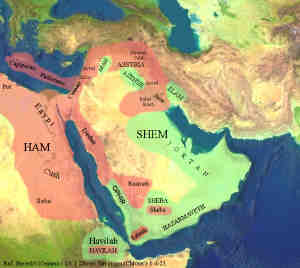
Sheba , son of Raamah. Has been connected with Sabaeans and peoples on either side of the narrowest part of the Red Sea , in both Yemen /South Arabia, and Eritrea /Ethiopia /Somalia .
http://en.wikipedia.org/wiki/Sheba
Biblical tradition
Sheba is mentioned several times in the Bible . For instance, in the Table of Nations (Genesis 10:7), Sheba, along with Dedan , is listed as a descendant of Noah 's son Ham (as sons of Raamah son of Cush ). In Genesis 25:3, Sheba and Dedan are listed as names of sons of Jokshan , son of Abraham . Another Sheba is listed in the Table of Nations (Genesis 10:28) as a son of Joktan , another descendant of Noah's son Shem . Yet another Sheba is mentioned in 2 Samuel 20:1-22 who rebelled against King David, was beheaded and his head thrown over the wall by the people in the city of Abel in order to save their lives.
In Ethiopian Orthodox tradition, the last of these three Shebas (Joktan's son) is considered the primary ancestor of the original Semitic component in their ethnogenesis , while Sabtah and Sabtecah , sons of Cush, are considered the ancestors of the Cushitic element.
Jewish -Roman historian Josephus describes a place called Saba as a walled , royal city of Ethiopia , which Cambyses afterwards named Meroe . He says "it was both encompassed by the Nile quite round, and the other rivers, Astapus and Astaboras " offering protection from both foreign armies and river floods . According to Josephus it was the conquering of Saba that brought great fame to a young Egyptian Prince , simultaneously exposing his personal background as a slave child named Moses .[4]
The Kitab al-Magall ("Book of the Rolls", considered part of Clementine literature ) and the Cave of Treasures mention a tradition that after being founded by the children of Saba (son of Joktan), there was a succession of sixty female rulers up until the time of Solomon . The Biblical tradition of the "Queen of Sheba " (named Makeda in Ethiopian tradition and Bilqis in Islamic tradition) makes its first appearance in world literature in 1 Kings 10, describing her as travelling to Jerusalem to behold the fame of King Solomon .
Owing to the connection with the Queen of Sheba, the location has thus become closely linked with national prestige, as various royal houses have claimed descent from the Queen of Sheba and Solomon . The most vigorous claimant has been and Eritrea , where Sheba was traditionally linked with the ancient Axumite Kingdom .
Islamic origins
The Qur'anic Queen of Sheba, Balqis, was a ruler who visited Solomon after receiving a letter from him inviting her to submit to God . The letter read, "In the Name of Allah , the Most Beneficent, and Most Merciful: be you not exalted against me, but come to me as Muslims (true believers who submit with full submission)" (27:30-31 Quran ). After visiting with King Solomon the Queen of Sheba said, "My Lord! Verily, I have wronged myself, and I submit (in Islam ), together with Sulayman, to Allah , the Lord of the Alamin (mankind, jinns , and all that exists)" (27:20-44 Quran ).
Archaeological considerations
See also: Queen of Sheba and Rulers of Sheba
Modern archaeological evidence increasingly supports Sheba being located in modern Yemen at or near the site of the famous Marib Dam , which was first built more than 2500 years ago.[5][6][7]
Some scholars suggest a link to the Sabaeans of southern Arabia.[8] A number of sources claim that the people of Sheba controlled trade in the Red Sea, and expanded at some point from Arabia into Africa to found trading posts in the lands currently called Eritrea and Somalia.[9][10]
In the medieval Ethiopian cultural work called the Kebra Nagast , Sheba was located in Ethiopia.[11] Some scholars therefore point to a region in northern Tigray and Eritrea which was once called Saba (later called Meroe), as a possible link with the Biblical Sheba.[12] Other scholars link Sheba with Shewa (also written as Shoa, modern Addis Ababa ) in Ethiopia.[13]
Ruins in many other countries, including Ethiopia , Somalia , Sudan , Egypt , Eritrea and Iran have been credited as being Sheba, but with only minimal evidence. There has even been a suggestion of a link between the name "Sheba" and that of Zanzibar ("San-Sheba").
Bibliography
Alessandro de Maigret. Arabia Felix, translated Rebecca Thompson. London: Stacey International, 2002. ISBN 1-900988-07-0
Andrey Korotayev . Ancient Yemen. Oxford: Oxford University Press, 1995. ISBN 0-19-922237-1 .
Andrey Korotayev. Pre-Islamic Yemen. Wiesbaden: Harrassowitz Verlag, 1996. ISBN 3-447-03679-6 .
References
1. ^ <http://www.cbc.ca/health/story/2000/09/12/sheba000912.html>
2. ^ <http://books.google.com/books?id=aM5hw9kZJ8sC&pg=PA160&lpg=PA160&dq=%2Bsheba,+%2Bmarib&source=bl&ots=lSNwgtEjnK&sig=4kiCYFlhHZwz3QJW9Of8apfzkVY&hl=en&ei=xNpZSrzOCeGrjAe18twa&sa=X&oi=book_result&ct=result&resnum=6>
3. ^ <http://books.google.com/books?id=2Vo-11umIZQC&pg=PA257&lpg=PA257&dq=%2Bsheba,+%2Bmarib&source=bl&ots=5QdSdWXuQS&sig=bCECpLzCkRBqWmDrdB8rgf5R9BI&hl=en&ei=pdpZSp6KJ4isjAfqgekb&sa=X&oi=book_result&ct=result&resnum=3>
4. ^ Josephus, Antiquities of the Jews II.10
5. ^ <http://www.cbc.ca/health/story/2000/09/12/sheba000912.html>
6. ^ <http://books.google.com/books?id=aM5hw9kZJ8sC&pg=PA160&lpg=PA160&dq=%2Bsheba,+%2Bmarib&source=bl&ots=lSNwgtEjnK&sig=4kiCYFlhHZwz3QJW9Of8apfzkVY&hl=en&ei=xNpZSrzOCeGrjAe18twa&sa=X&oi=book_result&ct=result&resnum=6>
7. ^ <http://books.google.com/books?id=2Vo-11umIZQC&pg=PA257&lpg=PA257&dq=%2Bsheba,+%2Bmarib&source=bl&ots=5QdSdWXuQS&sig=bCECpLzCkRBqWmDrdB8rgf5R9BI&hl=en&ei=pdpZSp6KJ4isjAfqgekb&sa=X&oi=book_result&ct=result&resnum=3>
8 ^ Stuart Munro-Hay, Aksum: An African Civilization of Late Antiquity, 1991
9. ^ Ethiopia in Pictures, bJeffrey Zuehlke
10 ^ The history of Ethiopia, by Saheed A. Adejumobi
11 ^ Edward Ullendorff, Ethiopia and the Bible (Oxford: University Press for the British Academy, 1968), p. 75
12 ^ The Quest for the Ark of the Covenant: The True History of the Tablets of Moses, by Stuart Munro-Hay
13 ^ Donald N. Levine, Wax and Gold: Tradition and Innovation in Ethiopia Culture (Chicago: University Press, 1972)
|